How to Read a Japanese Auction Sheet

When choosing a car from Japan, the first thing most people look at is the Japanese auction sheet: the auction’s condition report and its grade. That makes sense, because Japanese auction sheets are one of the biggest advantages of buying a car from Japan. Every car is inspected by the auction’s own inspector and described in a standard format, from the kilometres to the smallest scratch.
There is more to reading an auction sheet than it may first seem, though. Below we go through a real sheet section by section, explain the grades and damage codes, and show how we read a sheet together with everything else to build a full picture of a car.
In this guide
- First, check the car can be imported
- Why Japanese auction sheets are so useful
- How to read a Japanese auction sheet
- Japanese auction grades explained
- Japanese auction sheet damage codes
- Reading a grade in context
- The same car at more than one auction
- Looking at the full picture
- Inspecting cars in person
- Frequently asked questions
- Getting started
First, check the car can be imported
Not all cars can be imported from Japan into Australia. Cars under 25 years old need to be on the SEV register, and cars 25 years or older come in under the older vehicle rules. Our import catalogue lists popular cars people import from Japan, with the route each one takes, and our SEVS guide explains how both routes work.
Why Japanese auction sheets are so useful
A large share of Japan’s used cars are bought and sold through dealer auctions, and most auctions use a condition report, usually called an auction sheet, as the information sheet for each car. It covers the car’s overall condition, specification, equipment and kilometres, along with any marks, damage or repairs the inspector found.
Auction condition reports are not there just for show. They are a regulated part of the auction process, completed by specially trained inspectors following each auction’s strict rules, and the auctions take responsibility for the accuracy of the information they provide. That is why Japanese auction condition reports are known worldwide and have such a good reputation, and why a car’s auction sheet can even affect its resale value later on, wherever in the world it ends up.
Japanese auctions can only be accessed by registered dealers in Japan. They are a wholesale network where dealers source cars for future retail, not a shop built for the general public. That makes them very different from a retailer’s listing, where the photos show a car that has already been cleaned, repaired and prepared for sale. At auction you see cars as they come in, and the auction sheet is how the auction describes each one honestly to the dealers bidding on it.
Because the auctions are a platform designed for dealers, the condition reports mainly record what matters to a dealer: damage, mechanical condition and the overall specification. Buying at auction is not the same as buying from a local retailer. Once a car is bought, it may need a clean or a detail, and sometimes additional repairs to make it roadworthy.
Auction sheets also include a standard mileage check. Cars with a replaced or altered odometer, or with kilometres that cannot be verified, are marked with a symbol next to the kilometres and a note in the comments section. It is one of the reasons cars bought at Japanese auctions come with such reliable information.
Once a car is bought, the Japanese export certificate adds another record: the odometer readings from the car’s previous inspections in Japan, which we compare with the auction sheet.
How to read a Japanese auction sheet
The diagram below labels each section of a real auction sheet, translated into English. It is for a 2021 Honda Vezel Hybrid (RU3) Hybrid Z Honda Sensing, a SEVS-eligible model, with 50,265 km.
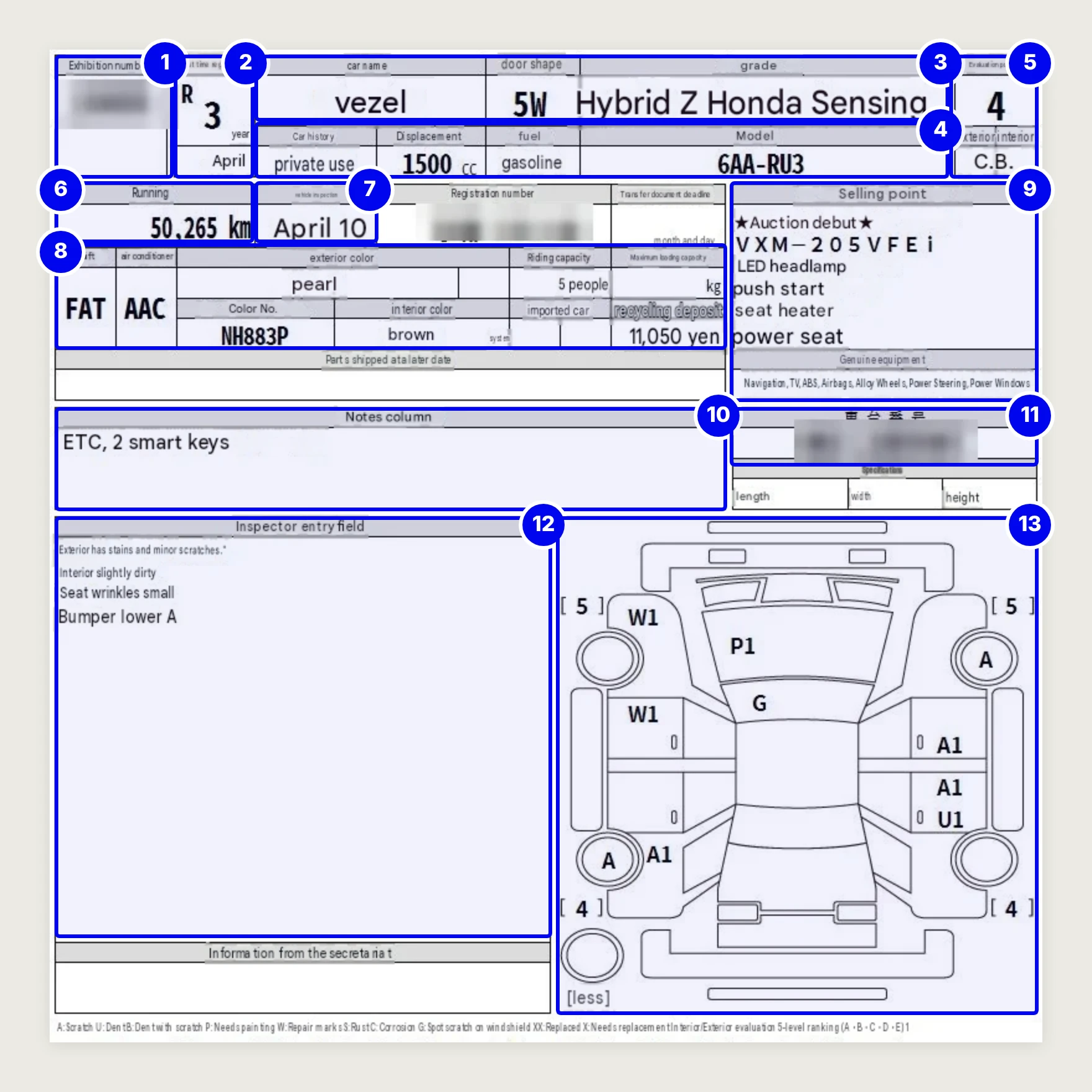
- 1Lot numberThe car’s number at the auction. Blurred here.
- 2First registrationR3 April: April in the 3rd year of Reiwa, which is 2021.
- 3Car name, body and gradeVezel, five-door wagon (5W), Hybrid Z Honda Sensing.
- 4History, engine and model codePrivate use, 1,500 cc, petrol hybrid, model code 6AA-RU3.
- 5Auction gradesOverall grade 4, with C for the exterior and B for the interior.
- 6Kilometres50,265 km, checked by the auction. A replaced or altered odometer is flagged here.
- 7Japanese inspection (shaken)Valid until April in Reiwa 10, which is 2028.
- 8SpecificationFloor auto (FAT), climate control (AAC), pearl paint NH883P, brown interior, five seats.
- 9Selling points and equipmentAuction debut, navigation, LED headlights, push start, seat heaters, power seat.
- 10NotesETC toll tag and two smart keys. Mileage and history notes also appear here.
- 11Chassis numberUsed to check the build date and history. Blurred here.
- 12Inspector’s reportStains and small scratches outside, interior slightly dirty, small seat wrinkles, a scratch under the bumper.
- 13Panel diagramWhere each mark is on the body: W1 repair marks, P1 paint, G stone chip, A1 scratches, U1 small dent.
And here is the original Japanese sheet next to our English translation. To get access to the latest auction listings and our daily monitoring service, use our $250 car search here.

Some auction sheets are typed, like this one, but many are handwritten, and the inspector’s notes can be hard to read. It is always best to check the meaning of any unclear notes with someone who knows how to read them. Any importer should be able to help with that, and we go through the notes on every car our clients are interested in.
A few things to look for on any sheet:
- Dates use the Japanese era calendar. R3 means the third year of Reiwa (2021), and H14 means the 14th year of Heisei (2002).
- The model code tells you exactly which version a car is. Here it is 6AA-RU3, the front-wheel-drive Vezel Hybrid.
- Selling points and notes show what comes with the car. This one has factory navigation, seat heaters, a power seat and two smart keys.
- The inspector’s report and panel diagram show its condition. On this Vezel, light stains and small scratches outside, small seat wrinkles, and a few small marks on the diagram, which fits a grade 4 car.

Japanese auction grades explained
Most auctions give each car an overall grade, plus separate letter grades for the exterior and interior. The scale varies a little between auction houses, but this is how it generally works:
| Grade | What it generally means |
|---|---|
| S or 6 | New or nearly new, usually with very low kilometres |
| 5 | Excellent condition with minimal wear, generally low kilometres |
| 4.5 | Very good condition with only light wear |
| 4 | Good, solid condition with minor marks for its age and kilometres |
| 3.5 | Average condition with noticeable wear, scratches or dents, or higher kilometres |
| 3 | Fair condition with more significant marks, or panels that need attention |
| 2 | Poor condition, often with corrosion |
| 1 | Flood history or other serious damage |
| R or RA | Can mean many different things, from repair history to modifications, current issues or simply poor overall condition. These cars need to be assessed more carefully |
| *** | Sold as is, without a full inspection |
Exterior and interior grades are letters. A is like new or exceptionally clean, B is good for the car’s age, C shows noticeable wear or marks, and D or E means heavier wear.
Japanese auction sheet damage codes
The letters on the panel diagram describe the type of mark, and the number after the letter shows its size, from 1 (small) to 3 (large).
| Code | Meaning |
|---|---|
| A1, A2, A3 | Scratch, from small to big |
| U1, U2, U3 | Dent, from small to big |
| B1, B2, B3 | Dent with a scratch, from about the size of a thumb to the size of an elbow |
| E1, E2, E3 | Dimples, from a few to many |
| W1, W2, W3 | Repair mark or wave in the panel, from hardly detectable to obvious |
| S1, S2 | Rust and heavy rust |
| C1, C2 | Corrosion and heavy corrosion |
| P | Paint marked |
| H | Paint faded |
| Y1, Y2, Y3 | Hole or crack, from small to big |
| X | Panel needs to be replaced |
| XX | Panel has been replaced |
| G | Stone chip in the glass |
| X1, R, RX | Small crack, repaired crack, or repaired crack that needs replacing on the windscreen |
Reading a grade in context
There are many different auctions in Japan, and each has its own way of judging cars. Some are more strict, others a bit more lenient. On its own, a grade does not tell you everything, but read alongside the auction it came from and the rest of the listing, it becomes a very useful guide.
Sales statistics help with this too. Below are three months of Honda Vezel (RU3) results from our search portal. The grade 4 car from the sheet above sold at TAA Kinki for ¥1,712,000.

Results like these show how grade, kilometres, specification and the auction all come together in the price. A 2019 car with 14,000 km graded 4.5, for example, sold for ¥1,875,000, while a 2020 car with 18,000 km graded 5 sold for ¥1,760,000. Knowing what comparable cars have sold for is how we help our clients set a sensible bidding limit.
The same car at more than one auction
Sometimes the same car comes up at more than one auction, and each auction’s inspector makes their own assessment. Here is a 2002 Mazda Roadster SP (NB6C) with about 207,000 km that was listed at three auctions in Osaka in October.


The two sheets are similar, with slightly different assessments. Both describe a five-speed SP with around 207,000 km and C grades for the exterior and interior. IAA Osaka graded it 3.5 and it sold there for ¥308,000. The later sheet also noted that the radiator core support and the front panels had been replaced, and graded it R.

This is why it is worth checking the statistics for a car’s previous listings at other auctions. Putting the sheets side by side gives you the complete picture, and it is one of the checks we do before recommending a car.
Looking at the full picture
When we look at a car for a client, we read the auction sheet together with:
- The auction and its location. How the auction tends to grade, and where in Japan the car has been. Cars from snowy regions, where roads are salted in winter, are worth a closer look underneath.
- The auction photos. The full set, which shows the interior, tyres and details the grade summarises.
- Underbody scans, if present. More auctions now include them, and they are especially useful for older cars.
- The notes under the condition report. The inspector’s comments often hold the most useful details.
- Any additional assessments. Independent inspections, when available, and the car’s previous auction history.

It helps to have an agent who knows how to interpret condition reports and put all of this together. Our guide to importing an R34 Skyline shows more underbody scan examples and what we look for in them.
To view the latest Japanese auction listings and use our monitoring service, start with our $250 car search. You get six months of access to auction and dealer listings and past sale prices, daily hand-picked listings for up to two chassis codes on WhatsApp, and our team to translate the sheets and go through the cars with you. Our article on where to view Japanese car auctions shows what that looks like.
Inspecting cars in person
When possible, it is always best to check a car in person at the auction, which we can do at major sites like USS Tokyo and USS Yokohama. In person we can look underneath the car, check the quality of any repairs, and confirm details such as the manufacture dates on parts like seatbelts, which help confirm a car’s age.


Frequently asked questions
How do I read a Japanese auction sheet?
Start with the grades, then check the model code, kilometres, first registration date and equipment. After that, read the inspector’s notes and the panel diagram, where letters and numbers mark each scratch, dent or repair. Read the sheet together with the photos, any underbody scan and the car’s previous auction history for the full picture.
What does grade 4 mean in a Japanese auction?
Grade 4 generally means a car in good, solid condition with minor marks for its age and kilometres. It is one of the most common grades for well-kept used cars.
What does an auction grade of 3.5 mean?
A 3.5 usually means average condition with some noticeable wear, scratches or dents, or higher kilometres. Many 3.5 cars are good buys, and the notes, photos and panel diagram show whether the marks are cosmetic.
What does A1 mean on a Japanese auction sheet?
A1 is a small scratch. The letter gives the type of mark (A for scratch, U for dent, B for dent with scratch, W for repair mark, S for rust) and the number gives the size, from 1 for small to 3 for large.
For real examples of rust (S) and corrosion (C) marks circled on Prado auction sheets, see our KZJ78W Land Cruiser Prado buying guide.
What does R mean on a Japanese auction sheet?
An R or RA grade can mean many different things, from repair history to modifications, current issues or simply poor overall condition. It does not rule a car out, but these listings need to be assessed more carefully, and we look closely at the notes, photos and previous auction history before recommending one. For a real example, read the story of the yellow grade R S15 Spec R we passed on, then bought.
Do Japanese auction sheets show if the kilometres are genuine?
Yes. Auction sheets include a standard mileage check. A car with a replaced or altered odometer, or kilometres that cannot be verified, is marked with a symbol next to the kilometres and a note in the comments section.
Why are Japanese auction photos often poor quality?
Japanese auctions are a wholesale network for registered dealers, not a retail showroom. The photos are taken by the auction to record each car as it arrives, before it has been cleaned or prepared for sale, so they are not meant to look like a retailer’s photos. That is why the auction sheet matters so much, and why we read it together with the full photo set and, where possible, an in-person inspection.
Can I buy directly from a Japanese car auction?
Not directly. Japanese auctions are a wholesale network open only to registered dealers in Japan, so private buyers in Australia buy through an agent with auction access, like us.
How do I get a Japanese auction sheet translated?
Every car in our $250 car search comes with its auction sheet, and we translate the sheet for any car you are interested in, including the inspector’s handwritten notes.
Getting started
Auction sheets are one of the best tools you have when buying a car from Japan, and reading them well is a big part of finding the right one. If you would like help finding and checking a car, the $250 car search is where every import with us begins. If you would rather talk it through first, call us on +61 404 312 508.
Disclaimer: this article is general information only. Grading scales and codes vary between auction houses, and the listings, grades and prices shown are examples from our portal at the time of writing. Import eligibility is decided by the Australian Government and can change, so please confirm eligibility for a specific vehicle with our team before purchasing. Nothing in this article excludes any right that cannot lawfully be excluded under the Australian Consumer Law.
Find us on socials
Our contacts