What It Costs to Import a Car from Japan to Australia
The first thing most people ask us is what a car from Japan will cost by the time it is parked in their driveway. The auction price is only the starting point. Between the hammer falling in Japan and the car leaving an Australian port there are about a dozen cost lines, and they are paid in stages as the car moves through the process.
Below we go through each of them in the order you will meet them, using the same estimator we send our clients. If you would rather start with the steps themselves, our import process page covers them from start to finish.
Which cars can be imported from Japan
The cars we import fall into two groups, and the group decides how the car is made road-legal at the end.
- SEVS-eligible cars (under 25 years old). Newer cars can only come in if the model is listed on the Specialist and Enthusiast Vehicle (SEV) register. These cars go through compliance at an approved workshop once they land. The Lancer Evolution VIII GSR is a good example, and we wrote about it in detail in our Evo VIII import guide.
- Cars over 25 years old. Once a car passes 25 years from its date of manufacture it no longer needs a SEV register entry. Instead of compliance, it may need engineering sign-off before registration, depending on the car and your state. A Toyota MR2 (SW20) or a Mazda RX-7 (FC3S) falls into this group.
Our import catalogue lists the JDM models eligible for import and which group each one falls under. Almost every cost below applies to both groups. The difference is at the end, where SEVS cars pay for compliance and older cars pay for engineering.
Every import starts with the $250 search
Every import with us starts with the $250 car search. It gives you access to our portal, where you can browse the newest listings at Japanese auctions and dealers along with past sales data for the model you are after.
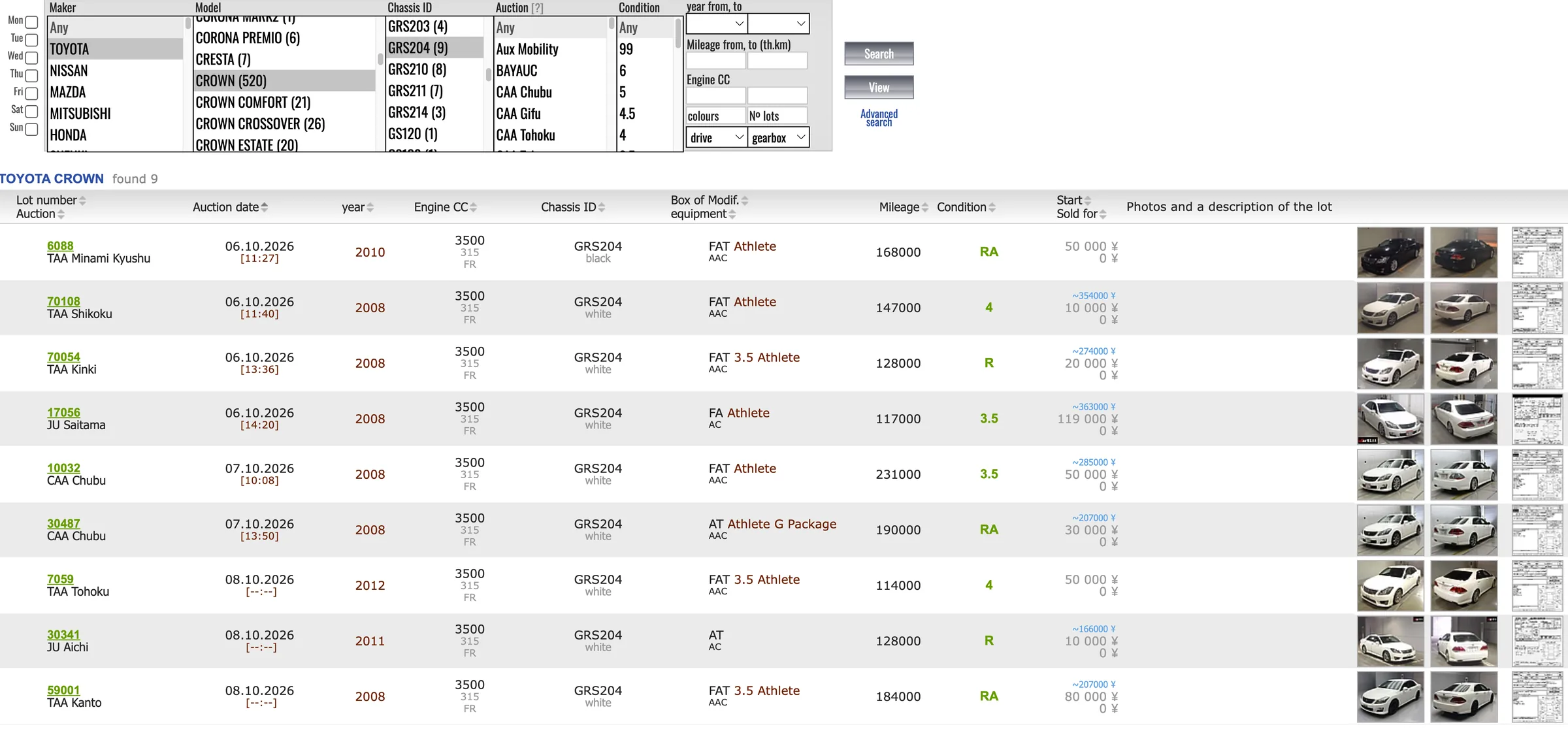
At the same time, we monitor the market for you. Every day from Monday to Saturday, for six months, we send you the latest matching cars for up to two chassis codes on WhatsApp. Our team shortlists every listing by hand. There is no automated feed and no AI picking cars for you. When a car catches your eye, we go through it with you: we translate the auction sheet, read the condition report and photos, and point out anything that suggests a listing is best left alone.
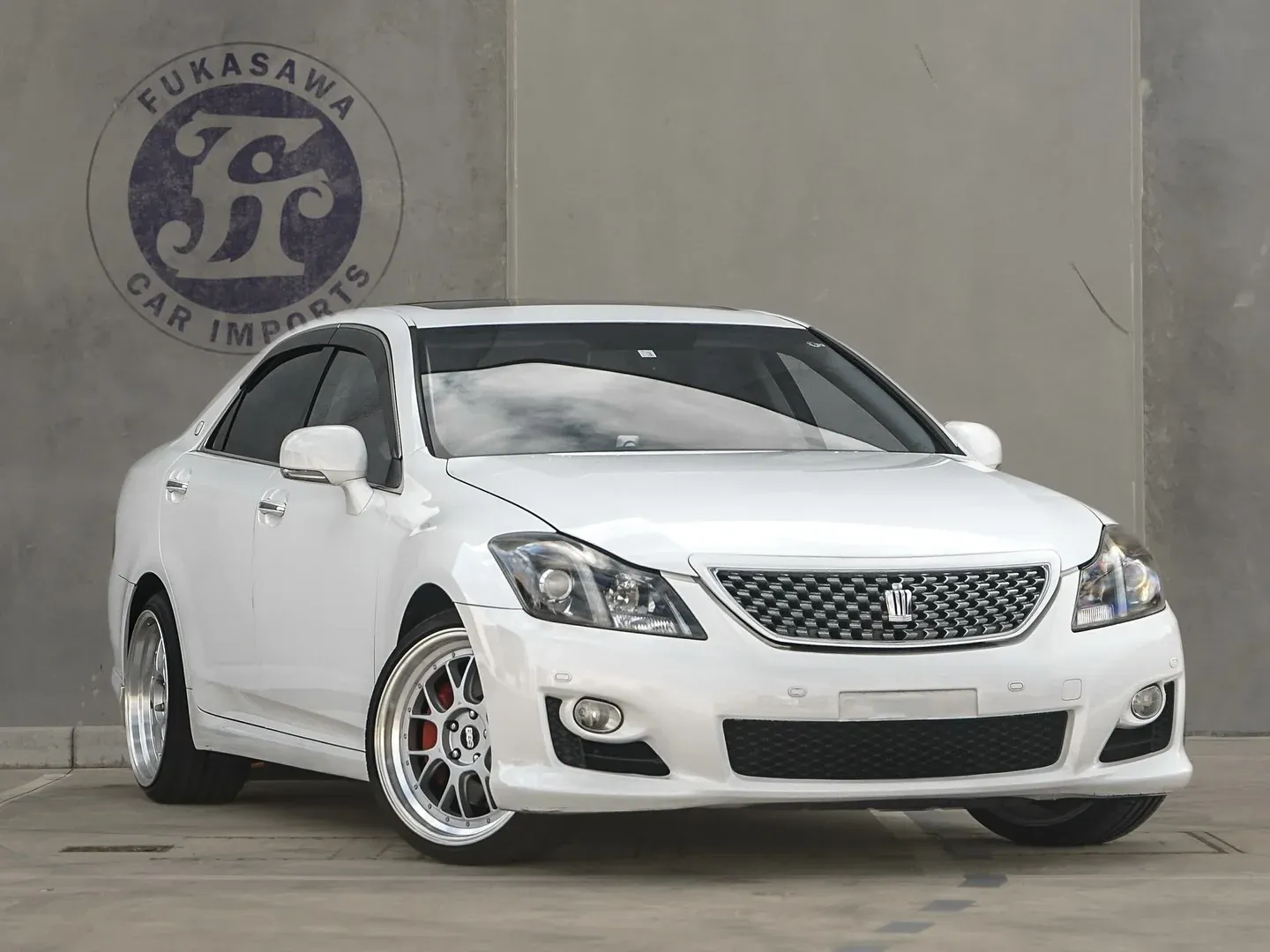
Each listing comes with an auction sheet and a full photo set. Below is one example: a 2010 Toyota Crown (GRS204) Athlete, a SEVS-eligible model, with 128,424 km on the clock, graded 4 overall with C for both exterior and interior. The original sheet is on the left and our translation is on the right.
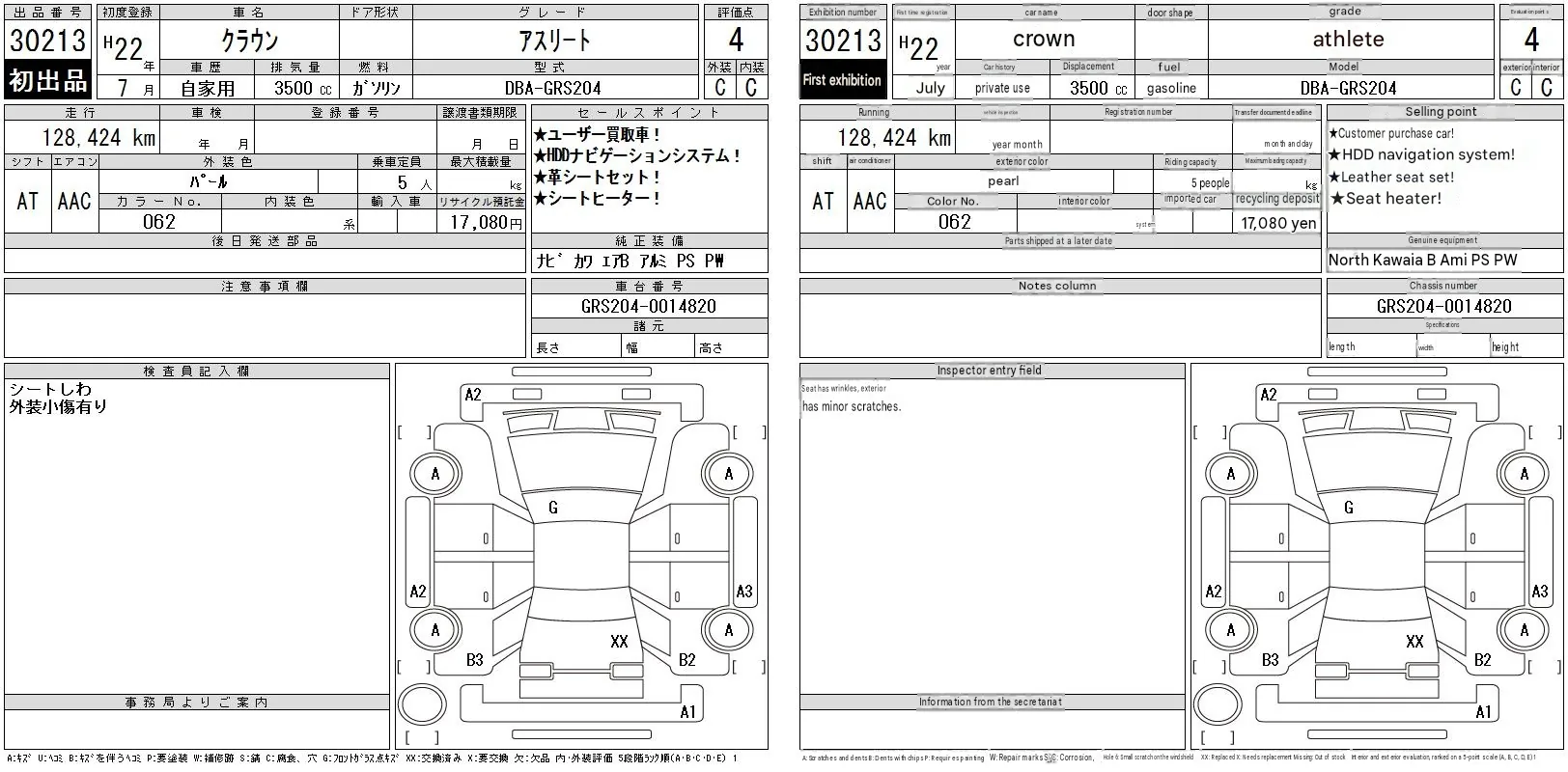
A sheet like this tells you a lot once you can read it. The car is marked as bought directly from its private owner. The inspector noted creasing on the seats and minor scratches on the body. The A and B codes on the panel diagram are small scratches and small dents. The G on the windscreen is a stone chip. The XX at the rear marks a part that has been replaced, and that is something we would ask the auction house about before bidding.
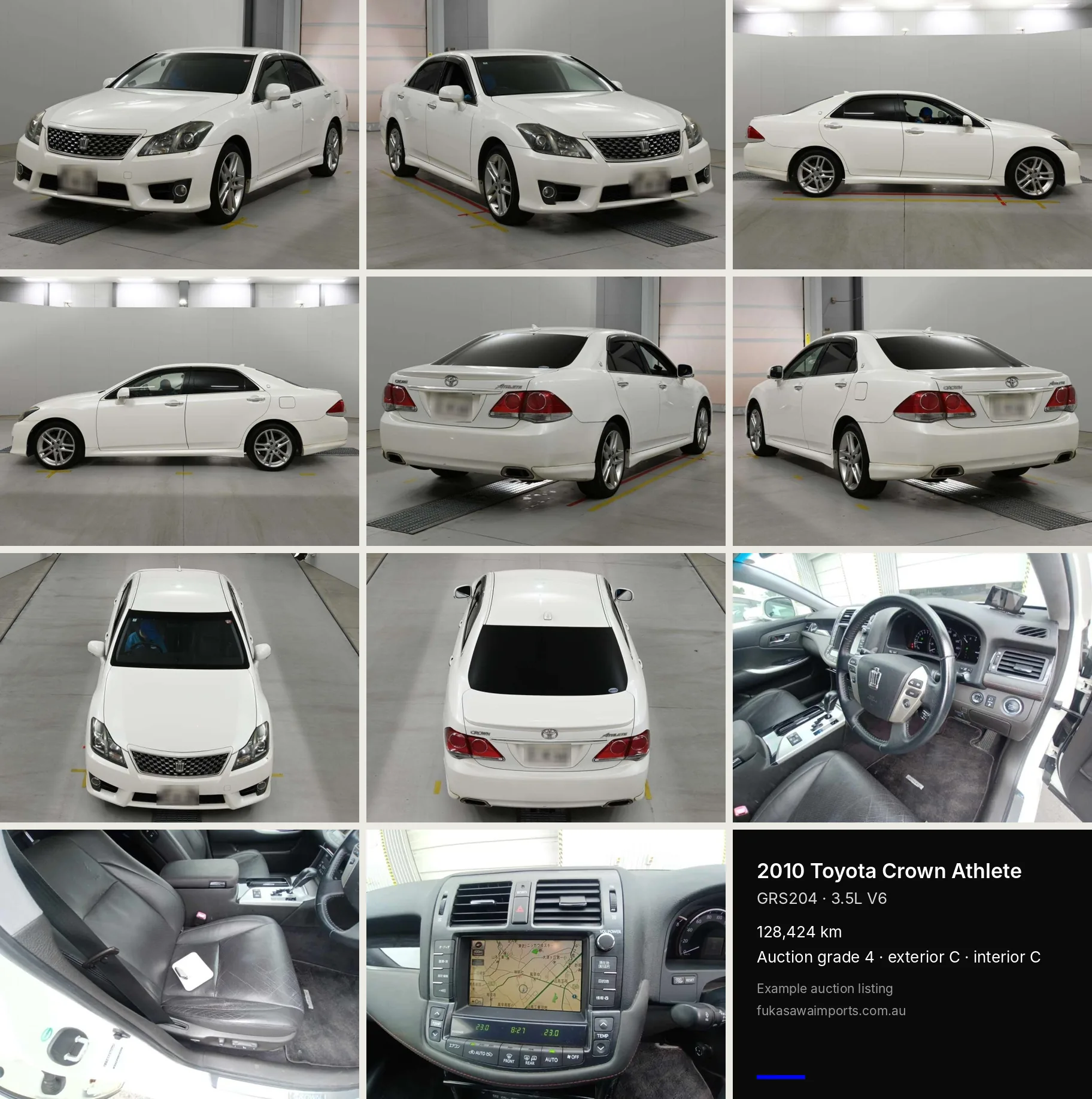
When you find the right car, you set a bidding limit you are comfortable with and we bid on your behalf at the auction. If we win it, everything that follows is calculated from the final purchase price.
How the costs are paid: six stages
You don’t pay the whole amount upfront. Each group of costs is paid as the import reaches that stage. This is the estimate we would send for a car bought at auction for ¥810,000:
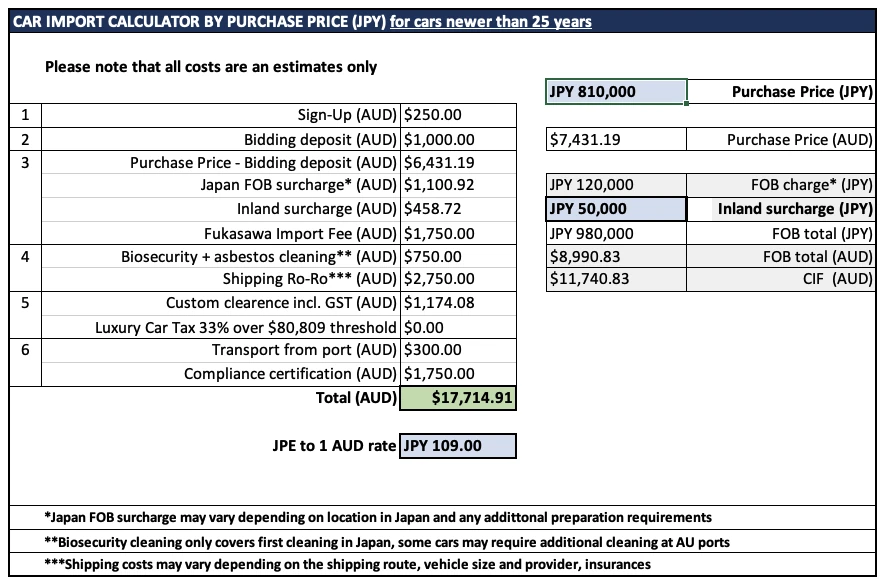
1. Sign-up: $250
This is the search fee covered above. It gives you access to the newest listings and the six months of daily updates.
2. Bidding deposit
Before we place a bid, you pay a bidding deposit. It stays on your file across every auction you bid on, and once you buy a car it goes towards the purchase price, which is why stage 3 shows the purchase price less the deposit. The deposit also protects both sides if a buyer changes their mind after a car has been bought. In that case it is used to cover the costs of cancelling or reselling the car, as set out in our service agreement. If you decide to stop before any car is bought, the full deposit is refunded when the search ends.
The deposit scales with the price you are bidding at:
| Purchase price in Japan | Bidding deposit |
|---|---|
| Up to ¥1,000,000 | $1,000 |
| ¥1,000,001 to ¥2,000,000 | $2,000 |
| ¥2,000,001 to ¥3,000,000 | $3,000 |
| ¥3,000,001 to ¥5,000,000 | $5,000 |
| ¥5,000,001 to ¥7,500,000 | $7,500 |
| Over ¥7,500,000 | $10,000 |
3. The car’s cost in Japan, plus our fee
This is the largest payment. It covers everything that happens in Japan.
- Purchase price less the deposit. This is the balance of what the car sold for, converted at the exchange rate on the day.
- Japan FOB surcharge. This covers the Japan side of the work. It pays for organising the purchase and the auction and agent fees, delivering the car from the point of sale to our yard or the port, and preparing it for export. Export preparation includes deregistration where needed, the export certificate and other paperwork, and help obtaining a valid import approval for Australia. For cars bought under ¥1,000,000 it is ¥120,000, and it steps up with the purchase price.
- Inland surcharge. We source cars from auctions and dealers all over Japan, from Hokkaido down to Kyushu. This charge covers any extra transport from where the car was bought to our yard or the nearest suitable port. Our yard is in the Tokyo region, so cars bought nearby carry the smallest inland charges.
- Fukasawa import fee. This is our fee for organising the whole import from start to finish. It is set by the purchase price, using the table below.
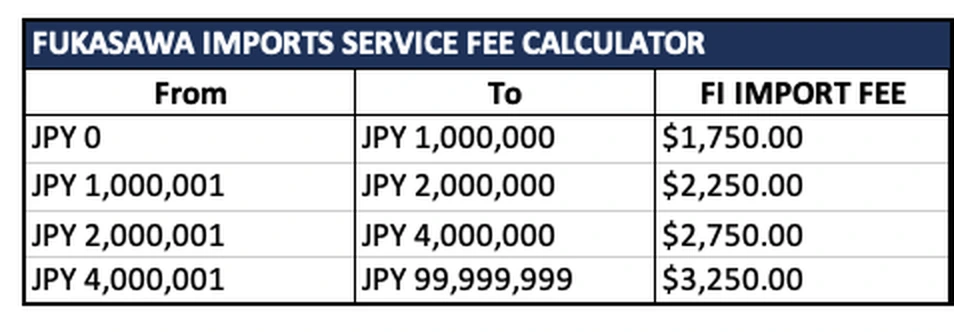
This stage usually takes three to six weeks from purchase, unless extra work is requested in Japan.
4. Biosecurity and shipping
Every car has to be prepared for Australian biosecurity before it ships, so that it is released at the port without problems. In most cases we do this in Japan. It includes heat treatment and, for older cars, extra cleaning for asbestos. The estimate covers the first clean in Japan. Some cars need further cleaning at the Australian port.
Shipping is the main transport cost. We use roll-on/roll-off (Ro-Ro) shipping for most cars because it is the most cost-effective way to move a car by sea. The price changes with the destination port in Australia and the size of the vehicle. Every car is covered by standard freight insurance against major damage or total loss, and extra cover is available if you want it. Once the ship leaves Japan, the trip usually takes up to about two weeks, depending on the vessel’s route and the weather.
5. Customs clearance and luxury car tax
We usually process this stage while the car is at sea. It covers the GST and other charges payable to bring the car into Australia, including port fees. Japanese-built cars generally don’t attract import duty under Australia’s free trade agreement with Japan, so for most of our imports this line is mainly 10% GST.
Higher-value cars may also attract luxury car tax (LCT). LCT is 33% of the amount by which the car’s value exceeds the threshold. For the 2026–27 financial year, the threshold is $80,809 for most cars and $91,661 for fuel-efficient vehicles. Cars built outside Japan but bought there, such as a BMW, Mercedes-Benz, Chevrolet, Porsche or Lamborghini, usually attract an extra 5% import duty. We include both in your estimate whenever they apply.
Customs and biosecurity processing can take anywhere from a few days to a few weeks before we receive port release for the car.
6. From the port to compliance
Once the car is released, a licensed tow truck takes it from the port. The cost changes if it needs to go somewhere other than the usual destination in Australia. The final line is compliance, which is the certification that makes a SEVS car eligible for registration in Australia. For cars over 25 years old, engineering takes the place of compliance, and its cost depends on the car. This stage usually takes one to three weeks.
After that, the car is landed and complied. A roadworthy certificate and registration in your state are the last steps, and they are paid separately.
The example, stage by stage
| Stage | What it covers | Amount |
|---|---|---|
| 1 | Sign-up | $250.00 |
| 2 | Bidding deposit | $1,000.00 |
| 3 | Car balance, FOB, inland, import fee | $9,740.83 |
| 4 | Biosecurity and shipping | $3,500.00 |
| 5 | Customs clearance incl. GST | $1,174.08 |
| 6 | Port transport and compliance | $2,050.00 |
| Landed and complied | $17,714.91 |
For a ¥810,000 car, about $7,400 at the example exchange rate, the total comes to roughly $17,700 landed and complied. Every figure is an estimate, and the final amounts depend on the exchange rate on the day, the car itself and where it is going.
Why the importer matters as much as the car
A large share of the risk in importing a car sits on the Australian side: customs, biosecurity, eligibility and compliance. An importer based here knows the local rules and has the contacts to get the approvals and certifications done. We outline all the major costs before we issue an invoice, so you know where the money goes at each stage.
We often hear from people who bought through an exporter in Japan and only found the extra costs once the car arrived. These include prices quoted in US dollars, customs clearance and port fees that weren’t in the original price, the cost of compliance, and in some cases cars with modifications that aren’t permitted here and that hold up the whole process. A knowledgeable agent can’t remove every cost, but it can make sure you know about each one before you commit.
If you have a model in mind, the $250 car search is where we start, and we can send you an estimate for a real car as soon as one comes up. If you would rather talk it through first, call us on +61 404 312 508.
Find us on socials
Our contacts