SEVS Explained: How the Specialist and Enthusiast Vehicle Scheme Actually Works
Almost every car we import from Japan comes into Australia through one of two routes. Cars that are 25 years or older can be imported under the older vehicle scheme. Newer cars can only come in if the model is listed on the Specialist and Enthusiast Vehicle (SEV) register, the system most people still call SEVS.
The 25-year rule is easy to understand. SEVS is less obvious, and it is the reason some modern Japanese cars can be imported and others cannot. Below we explain what SEVS is, why it exists, how a car gets onto the register, and what happens to your car between the auction and the number plates.
This article is a general overview to help you understand how the system works. It is not legal or compliance advice, and the rules change from time to time. Eligibility for any specific car is decided by the Australian Government, and must be confirmed for that exact car before you buy.
Why SEVS exists
Australia has long had a pathway for importing small numbers of vehicles that were never sold here new. From 1970 it was called the Low Volume Scheme, and it was meant for specialist and enthusiast cars. By the 1990s it had become a route for importing large numbers of everyday used cars. According to a Senate committee report on the scheme, these imports grew from around 1,000 cars in 1993 to 16,825 in 2000.
In response, the government replaced it with the Specialist and Enthusiast Vehicle Scheme and the Registered Automotive Workshop Scheme, which started on 1 April 2002. The stated aims were to limit imports to vehicles that are genuinely specialist or enthusiast in nature, to give better assurance that imported cars meet Australian safety and emissions standards, and to reduce malpractice in the used import trade.
In simple terms, SEVS does two jobs. It controls which models can be imported, so they do not compete with cars already sold here new, and it makes sure every imported car is modified to Australian standards in the same, consistent way.
The scheme was updated under the Road Vehicle Standards Act 2018, which took effect on 1 July 2021, with the old rules fully phased out by 30 June 2023. The scheme now runs through the SEV register and Registered Automotive Workshops (RAWs) under updated eligibility criteria, and some models that could be imported under the old scheme are not on the current register.
The six SEV criteria
To be entered on the register, a model must meet at least one of six criteria set by the federal government:
- Performance. High-performance vehicles with specifications significantly better than mainstream cars sold in Australia. Most of the JDM cars our clients ask about, from Evos to GT-Rs, sit here.
- Environmental performance. Vehicles that meet or exceed the current emissions standards that apply in Australia.
- Mobility. Vehicles built or modified with features to help people with a disability, such as wheelchair access or swivel seats.
- Left-hand drive. Cars originally built as left-hand drive, where no right-hand-drive version is available in any other country.
- Campervans and motorhomes. Vehicles built as, or capable of being converted into, a campervan or motorhome.
- Rarity. Vehicles produced in small numbers.
There are two more conditions. The vehicle must have been on sale overseas for at least three months, and, apart from a few limited exceptions, it must never have been sold new in Australia. This is what keeps SEVS from competing with local dealers. A model that has been sold new through Australian showrooms will generally not qualify, however interesting the Japanese version is.
How a car gets onto the SEV register
Adding a new model to the register is a big undertaking. Although anyone can lodge the application, in practice it is done by Registered Automotive Workshops, because an entry is only useful once a Model Report (the engineering blueprint explained below) has been engineered, tested and approved, and a workshop has been approved to work to it. That takes considerable time and money, so workshops only take it on when there is a very good reason, usually a model they expect to comply in reasonable numbers.
Getting a car onto the register is not something done for a one-off import. If the car you want is not listed yet, it usually makes more sense to choose an eligible model, or wait until your preferred car turns 25.
Register entries are made per model, not per car. Once a model is listed and the paperwork behind it is in place, every car of that model follows the same path.
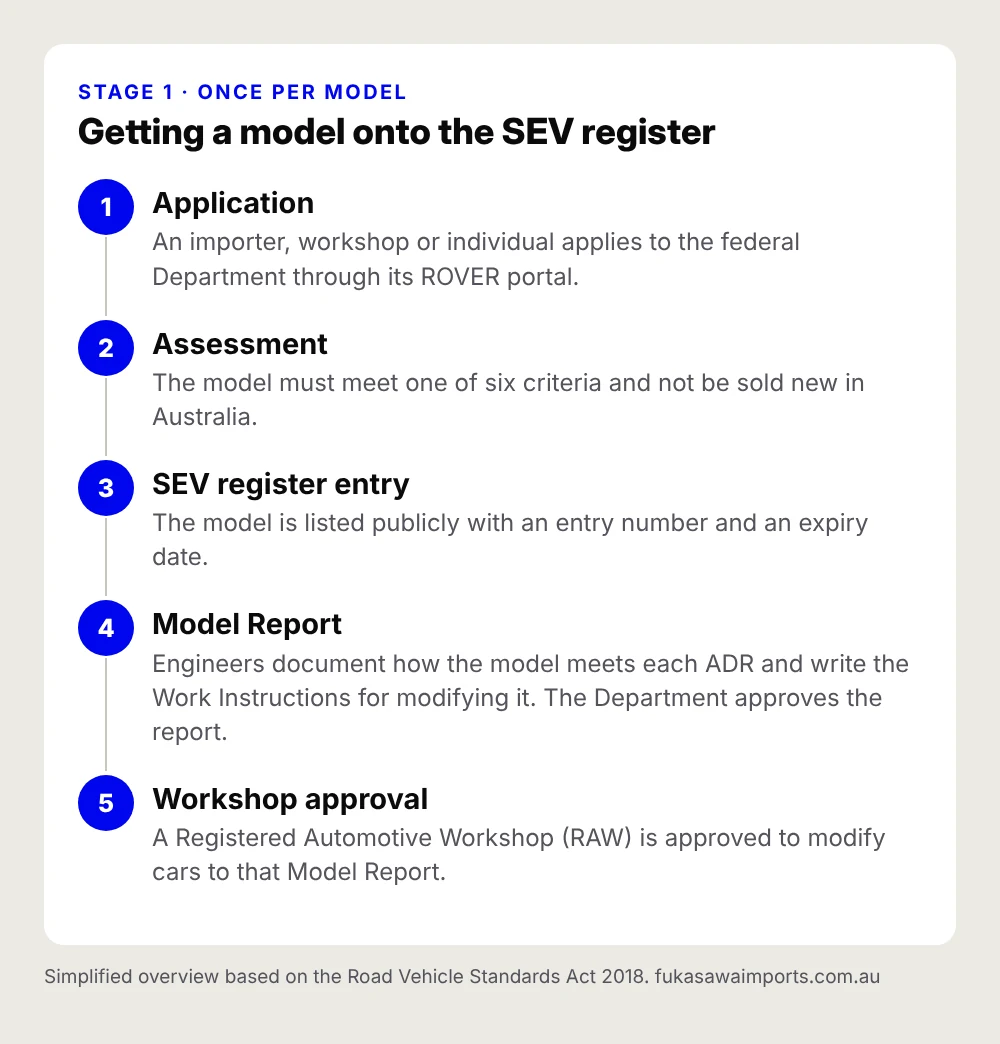
Anyone, whether an importer, a workshop or an individual, can apply to have a model added to the register through ROVER, the federal Department of Infrastructure’s online portal. The Department checks the model against the criteria above and the not-sold-here-new rule. If it passes, the model is listed on the public register with an entry number and an expiry date. Entries are snapshots in time, so we always check the official SEV register before a client bids.
ADRs and Model Reports: the blueprint for compliance
Every car on Australian roads has to meet the Australian Design Rules (ADRs), the national standards for vehicle safety, emissions and anti-theft. They cover things like seatbelts and child restraint anchorages, lighting, brakes, speedometers and exhaust emissions. A Japanese-market car was built to Japanese rules, so it usually needs some changes before it meets every ADR.
Being on the register only means a model is eligible. Before any car of that model can be complied, engineers have to prepare a Model Report. This is effectively a blueprint for that model. It documents how the car meets each relevant ADR, with test evidence, and contains Work Instructions setting out exactly what has to be changed. The Department reviews and approves the Model Report. A Registered Automotive Workshop then gets approval to modify cars to that report. Approved Model Reports are published in ROVER’s list of approved Model Reports, alongside the SEV register.
Because of this, every car of a given model is complied the same way, by an approved workshop, following approved instructions. For buyers, it also means there is a practical check before bidding: is there an approved Model Report for this exact model, and a workshop that can do the work?
Being on the register does not guarantee a car can be imported
A model appearing on the SEV register does not on its own mean a particular car is eligible to be imported. The register is best used as a guide. From there, importers check the Model Reports approved for that model, which they use to verify the details and assess individual cars before anything is bought.
Every SEV entry has an expiry date. Separately, the model needs an approved Model Report, which has its own requirements, build date ranges and approval status, and not every entry has one. A model can be on the register while a particular variant, grade or build date falls outside what the Model Report covers.
The general rule we follow is to only consider cars that are covered by both the SEV register entry and the Model Report. The SEV entry must still be current when the import approval is decided, so we also leave a safe margin before the entry and Model Report expire.
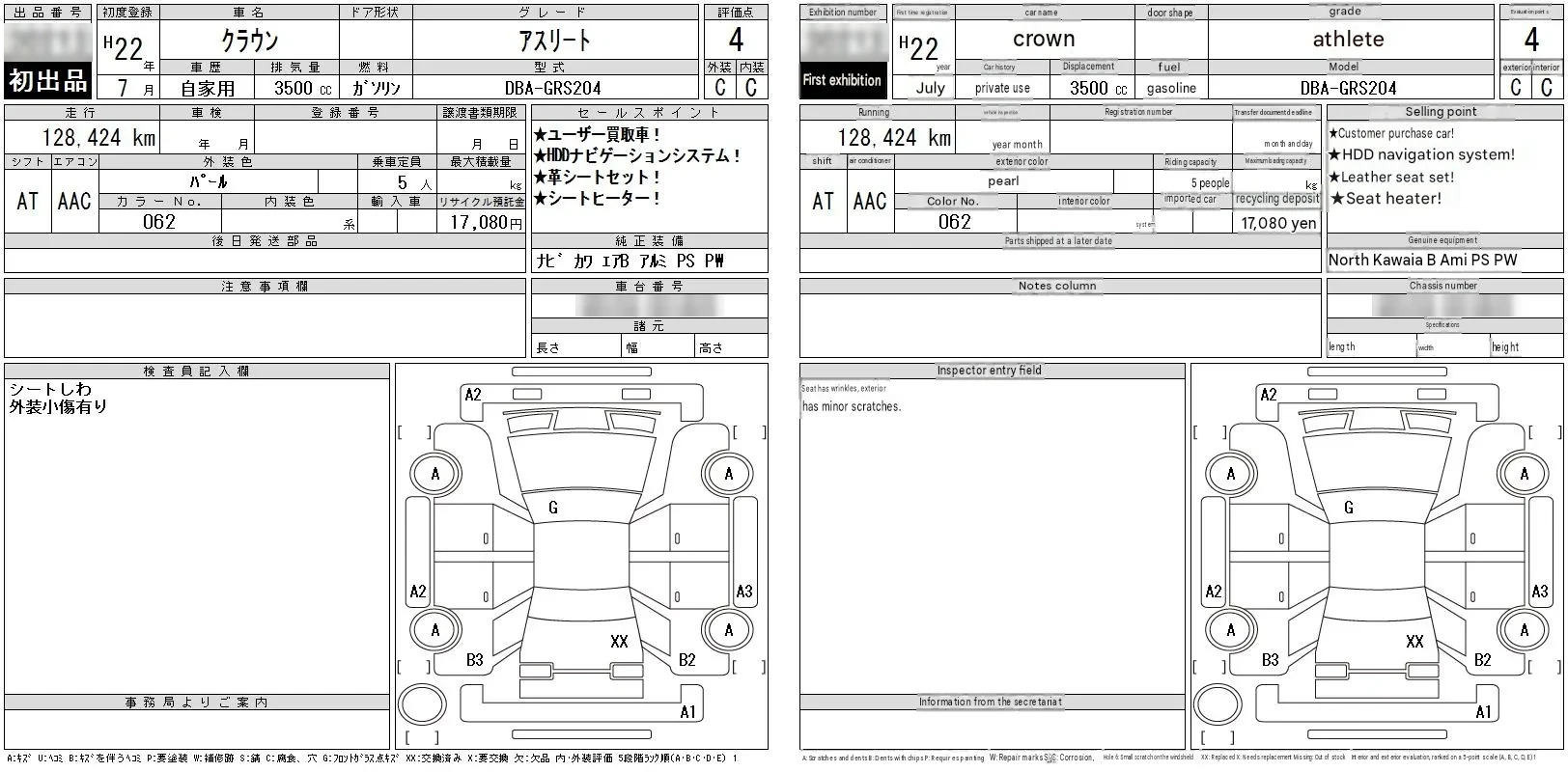
Finally, every car has to be checked on its own. Modifications, defects and damage can all stop an otherwise eligible car from being imported or complied, which is why we go through each car’s auction sheet, photos and condition report before a client bids.
Examples from our catalogue
Here is how a few popular models look on the register. Each catalogue entry links to its SEV register listing, so you can see the details for yourself:
| Model | SEV entry | Criterion | Build dates covered | Entry expires |
|---|---|---|---|---|
| Toyota Crown (GRS204) | SEV-000725 | Performance | 02/2008 to 07/2013 | 27 Nov 2027 |
| Toyota Crown Hybrid (GWS204) | SEV-000726 | Performance | 02/2008 to 07/2013 | 27 Nov 2027 |
| Mitsubishi Lancer Evolution VIII GSR / MR (CT9A) | SEV-000875 | Performance | 01/2003 to 04/2004 | 15 May 2028 |
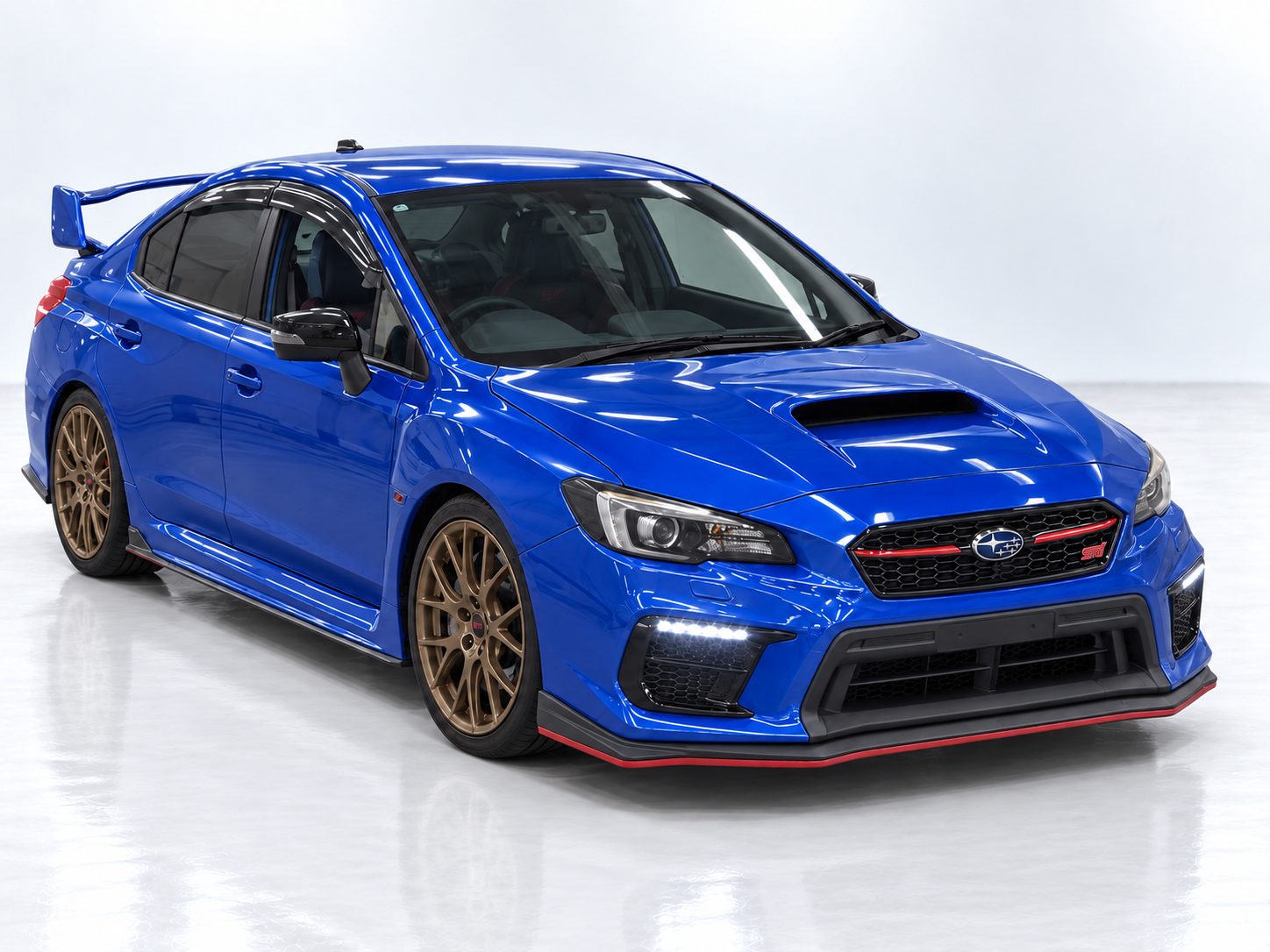
| Subaru WRX STI (VAB) | SEV-001017 | Performance | 07/2014 to 12/2021 | 13 Jan 2029 |
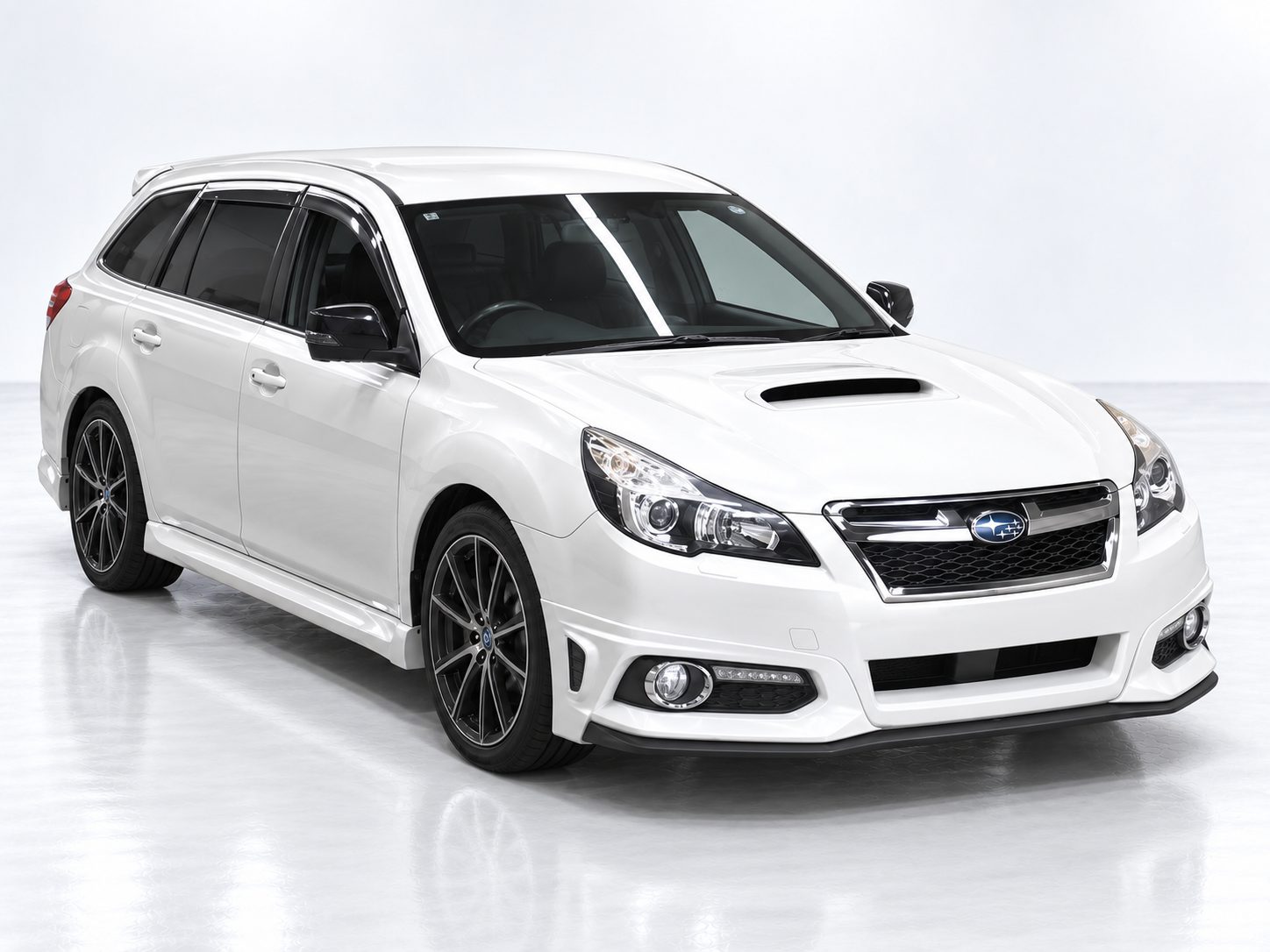
| Subaru Legacy Wagon (BRG) | SEV-000897 | Performance | 02/2012 to 09/2014 | 29 Jun 2028 |
| Nissan Skyline R34 GT-R (BNR34) | SEV-000768 | Performance | 01/1997 to 12/2002 | 2 Feb 2028 |
Notice how specific the build dates are. The Evolution VIII entry, for example, covers cars built between January 2003 and April 2004, so a car built outside that window is not covered by it. Entries can be narrower still. The Legacy entry only covers the BRG wagon with the turbocharged 2.0 litre FA20 engine, and the WRX STI entry only covers VAB cars with the 2.0 litre EJ20 engine. Our import catalogue lists the SEV entry, criterion and expiry date on each SEVS model’s page.
From auction to registration: the client’s view
Here is the whole process for one car, in the order it happens. At Fukasawa Car Imports we organise all of this paperwork on our clients’ behalf, from the import approval to the compliance booking, but it helps to know what each step is for.
- Eligibility check before bidding. We confirm the car qualifies, either because it is 25 years or older or because its exact model and build date are covered by a current SEV register entry. For SEVS cars we also confirm a Model Report and workshop are available.
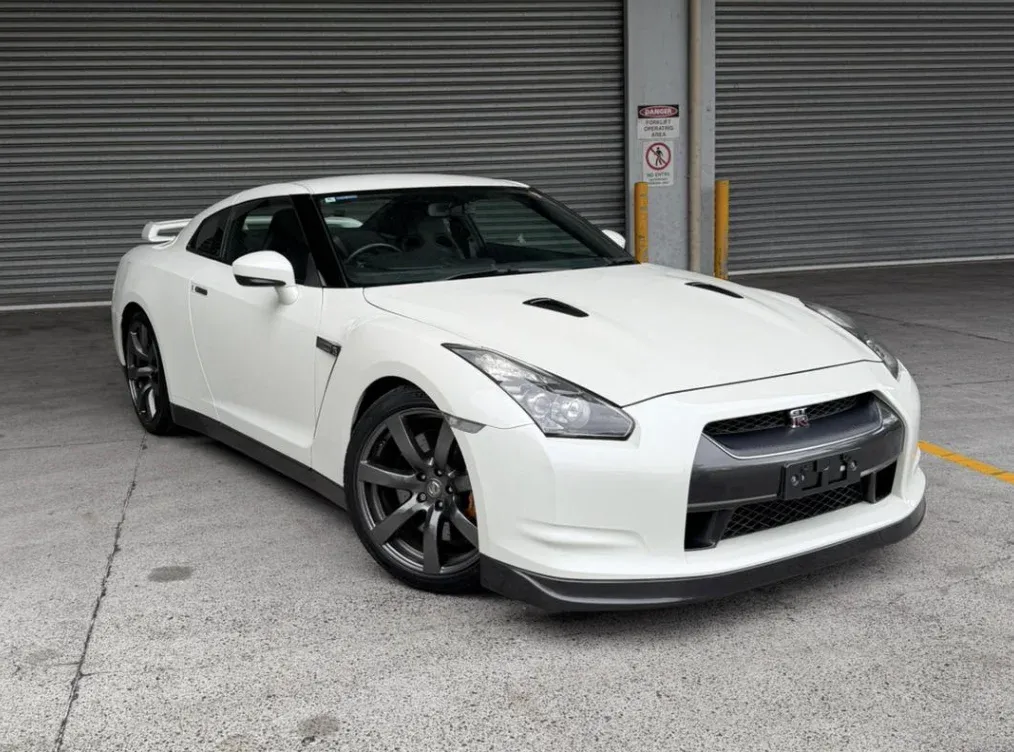
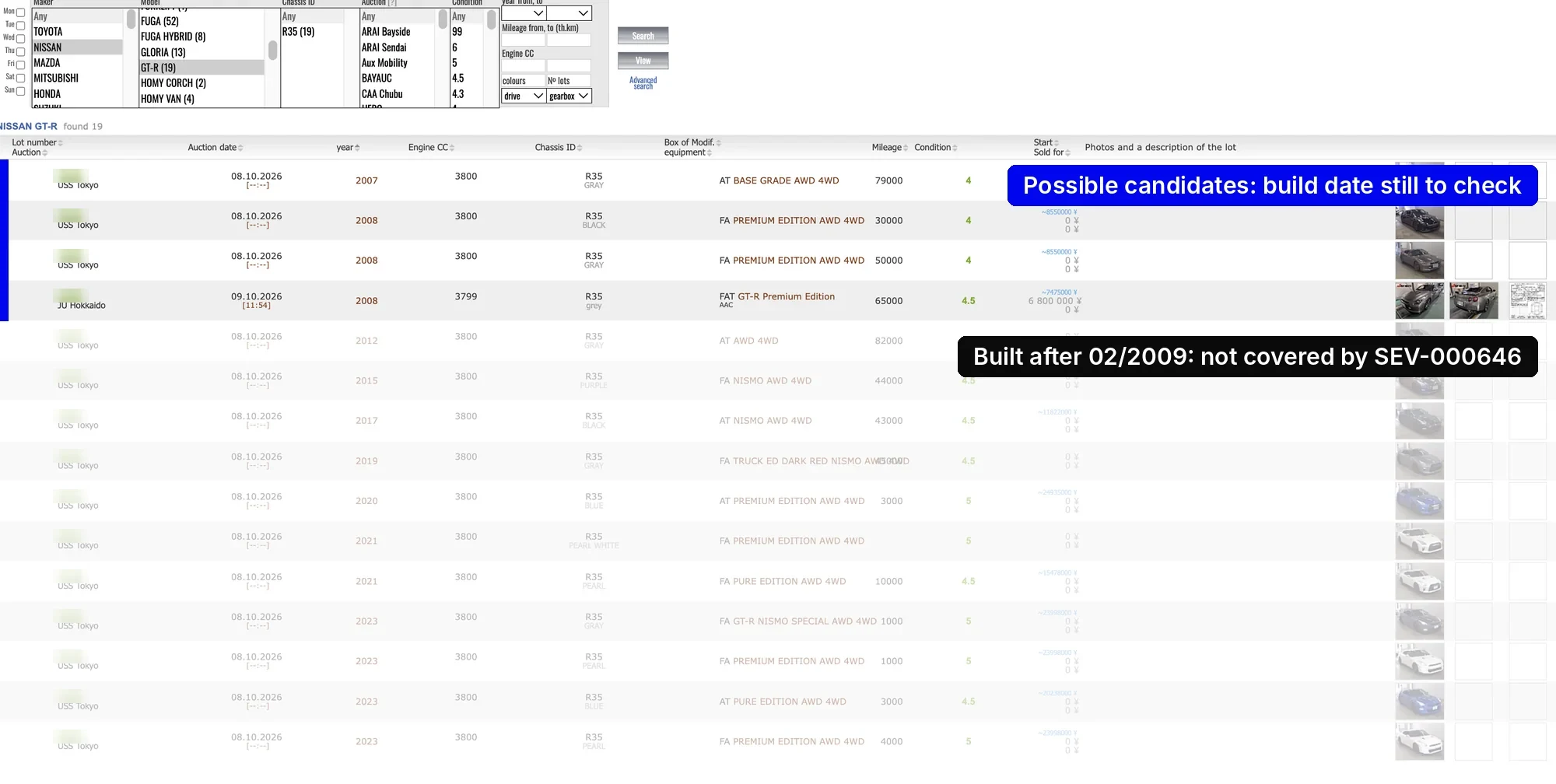
Here is what that check looks like in practice. The SEV register entry for the R35 Nissan GT-R, SEV-000646, only covers cars built between November 2007 and February 2009.

On the auctions for 8 and 9 October 2026, 19 R35 GT-Rs came up in Japan. Every car from 2012 onwards falls outside the entry straight away, which leaves four 2007 and 2008 cars as possible candidates. Each of those still needs its exact build date confirmed against the entry and Model Report, and its condition and any modifications checked. A heavily modified car is ruled out even if its build date fits. We go through every upcoming car this way, by hand, before anything is sent to a client.
- Purchase and export paperwork in Japan. Once we buy the car, it is deregistered in Japan and an export certificate is issued. This document confirms the car’s identity and Japanese registration details, and it is one of the documents used to support the import approval application, including as evidence of the car’s identity and age.
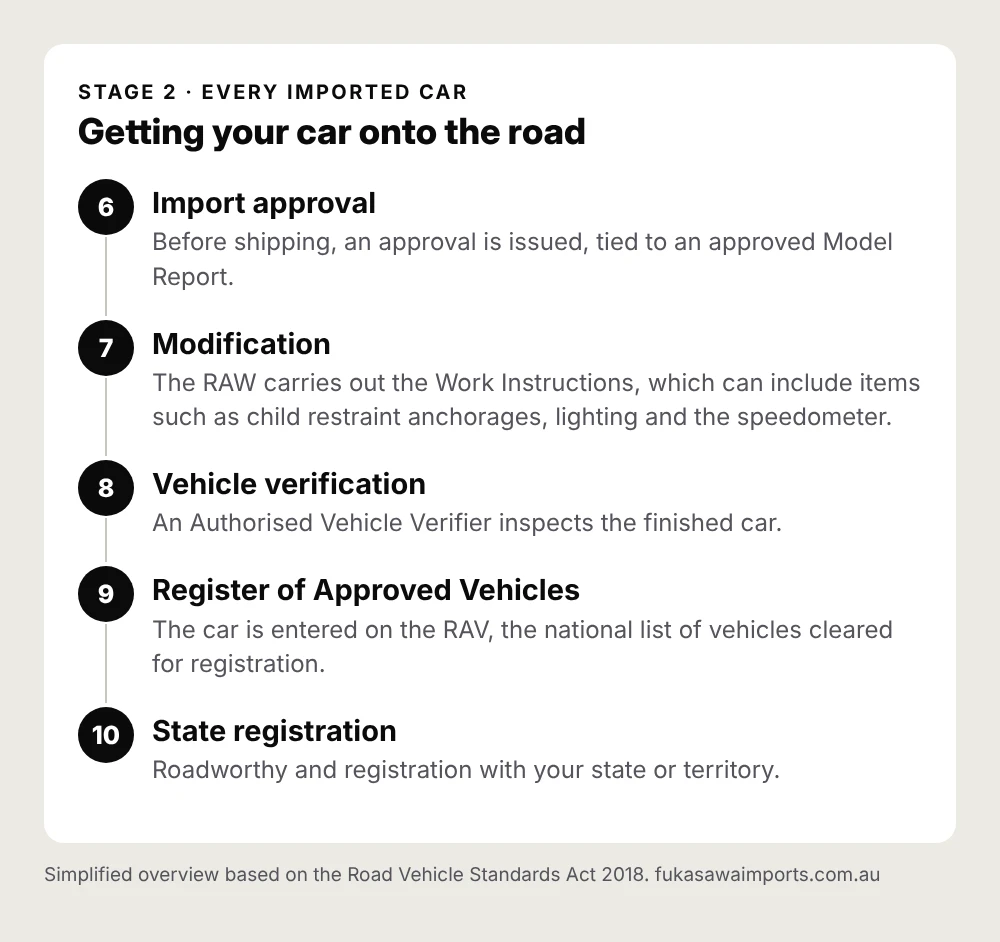
- Vehicle import approval. Every road vehicle needs an import approval for that specific car, applied for through ROVER with the car’s details, chassis number and photos. For a SEVS car, this is a concessional RAV entry approval, which also acts as the import approval. It is tied to an approved Model Report, and the car must be modified by a Registered Automotive Workshop and checked by an Authorised Vehicle Verifier. For a 25-year-old car, the approval also allows the car to be entered on the Register of Approved Vehicles, provided it has not been significantly modified in the last 25 years. The approval must be granted before the car is shipped to Australia. A car shipped without one can end up stuck at the border.
- Shipping and customs clearance. As the car is shipped, a customs broker lodges the import declaration with the Australian Border Force, including the import approval and shipping documents. GST of 10% is paid at this stage, plus luxury car tax if the car’s value is above the threshold. Cars built in Japan are generally free of customs duty under the Japan-Australia free trade agreement, while cars built elsewhere usually attract 5% duty. Every imported car must also be free of asbestos before it is shipped. Older cars are higher risk, so parts such as gaskets, brake pads and clutch linings may need testing or replacement first.
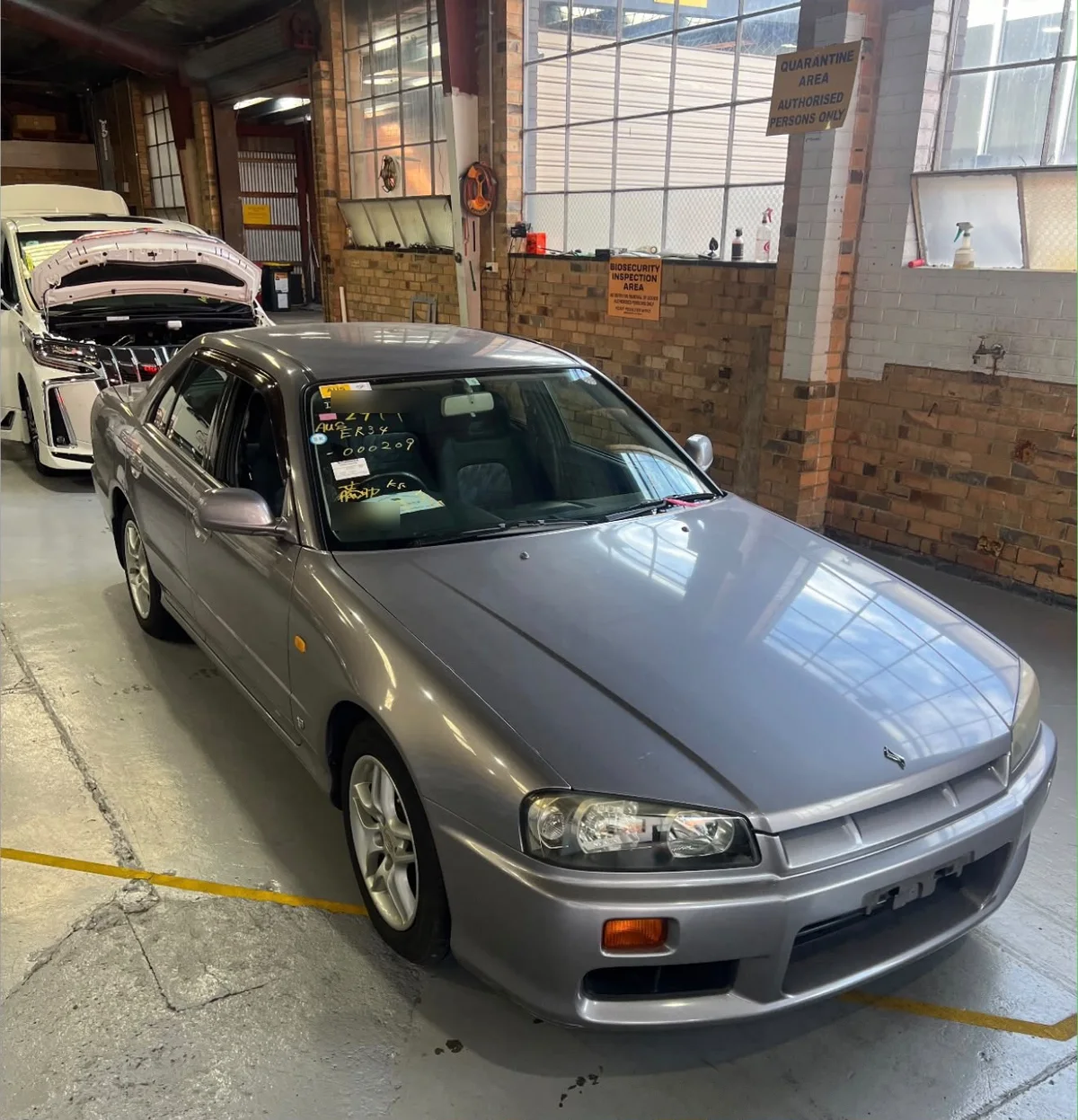
- Biosecurity clearance. The car is inspected to make sure it is free of soil, plant and animal material. The car is usually cleaned before it leaves Japan, and it is only released from the port once biosecurity is satisfied.
- Compliance. For a SEVS car, the RAW carries out the Model Report’s Work Instructions. An Authorised Vehicle Verifier then inspects the finished car before it is entered on the Register of Approved Vehicles (RAV), the national list of vehicles cleared for registration in Australia. A car imported under the 25-year rule has no Model Report to follow. Its requirements are set by the state it will be registered in. In Victoria, NSW and WA, for example, it must meet the ADRs that applied when it was built, and it is modified as needed before registration.
- Roadworthy and registration. With the car on the RAV, it gets a roadworthy certificate and is registered with your state or territory, which may have extra requirements of its own.
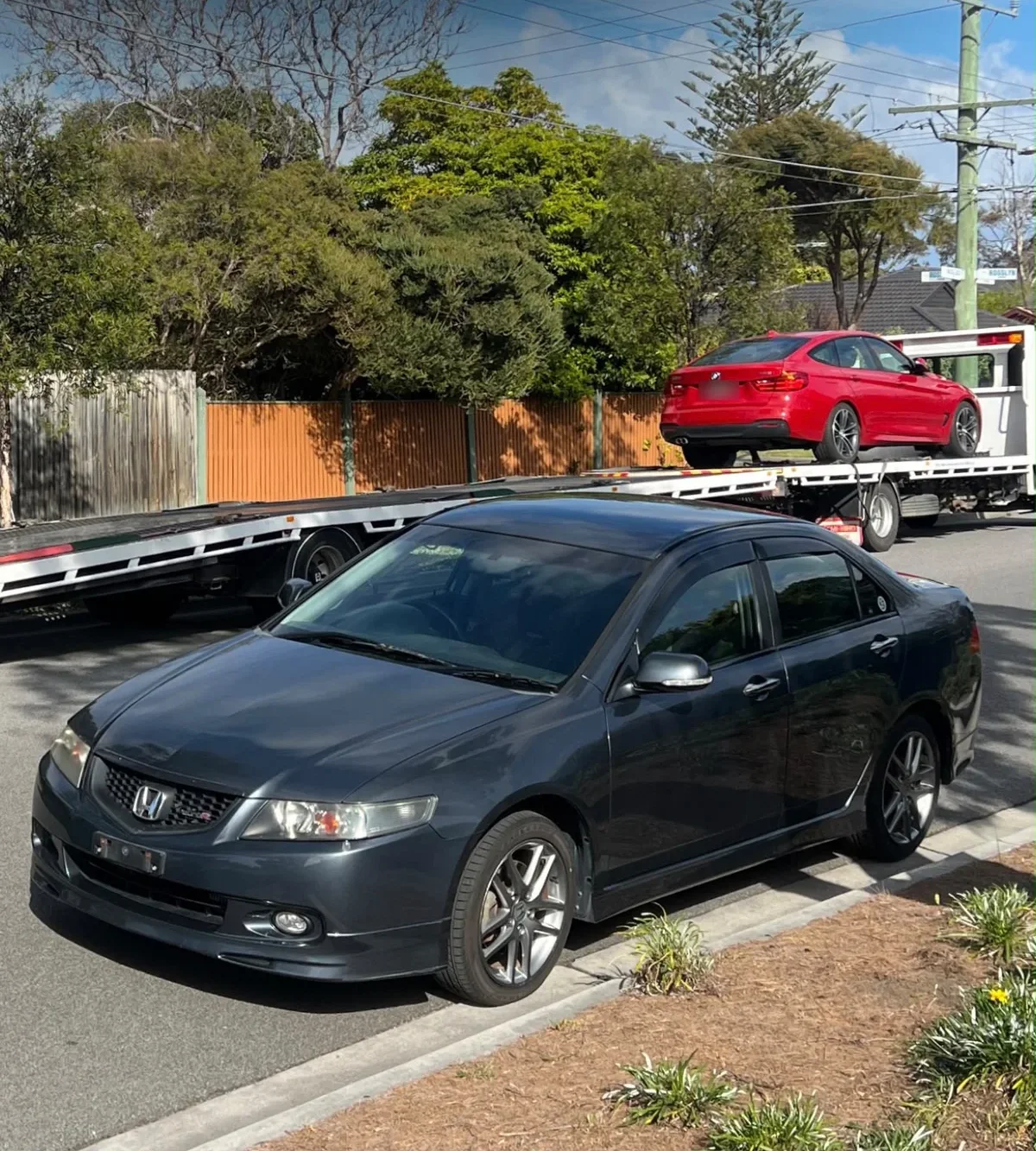
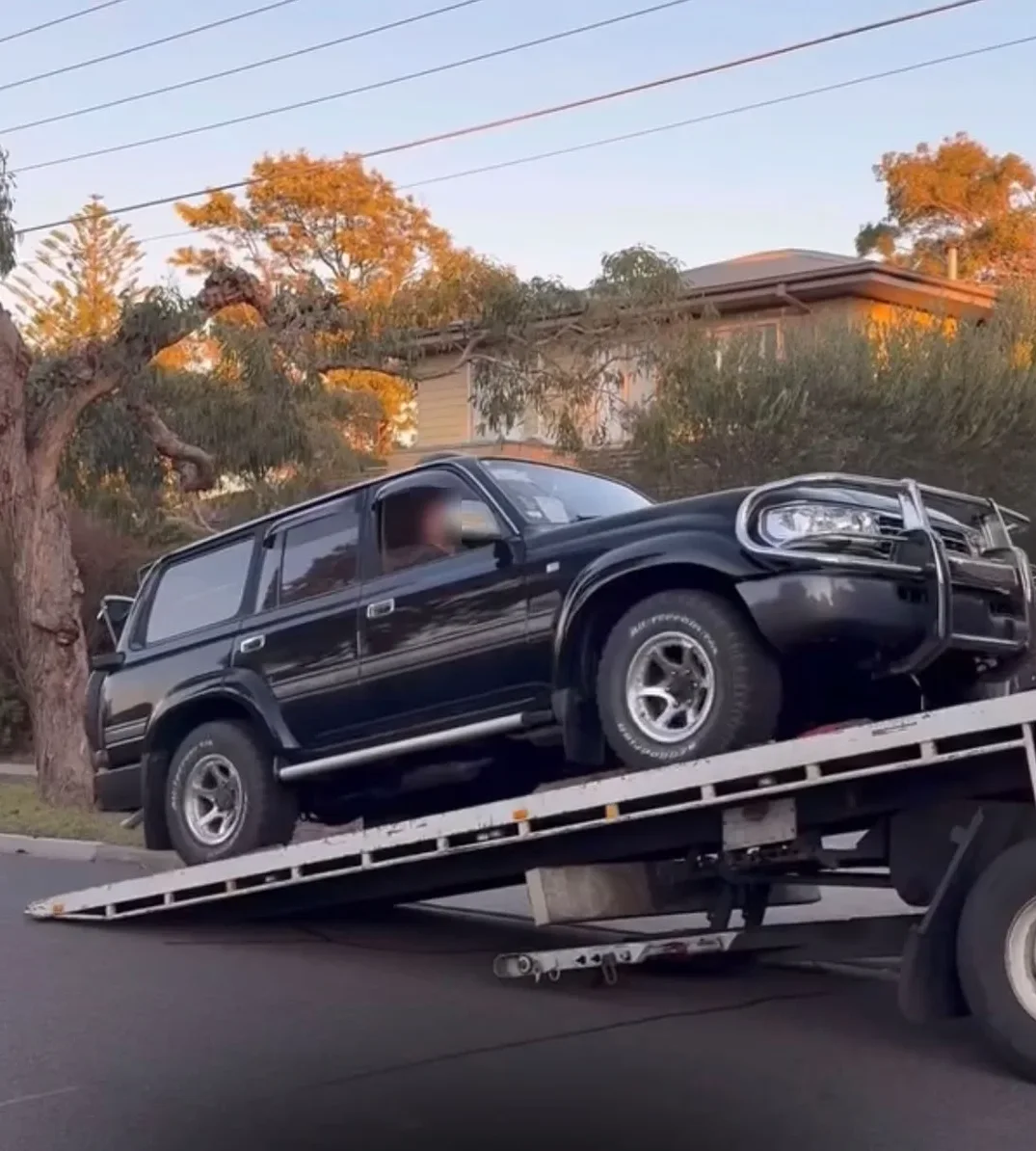
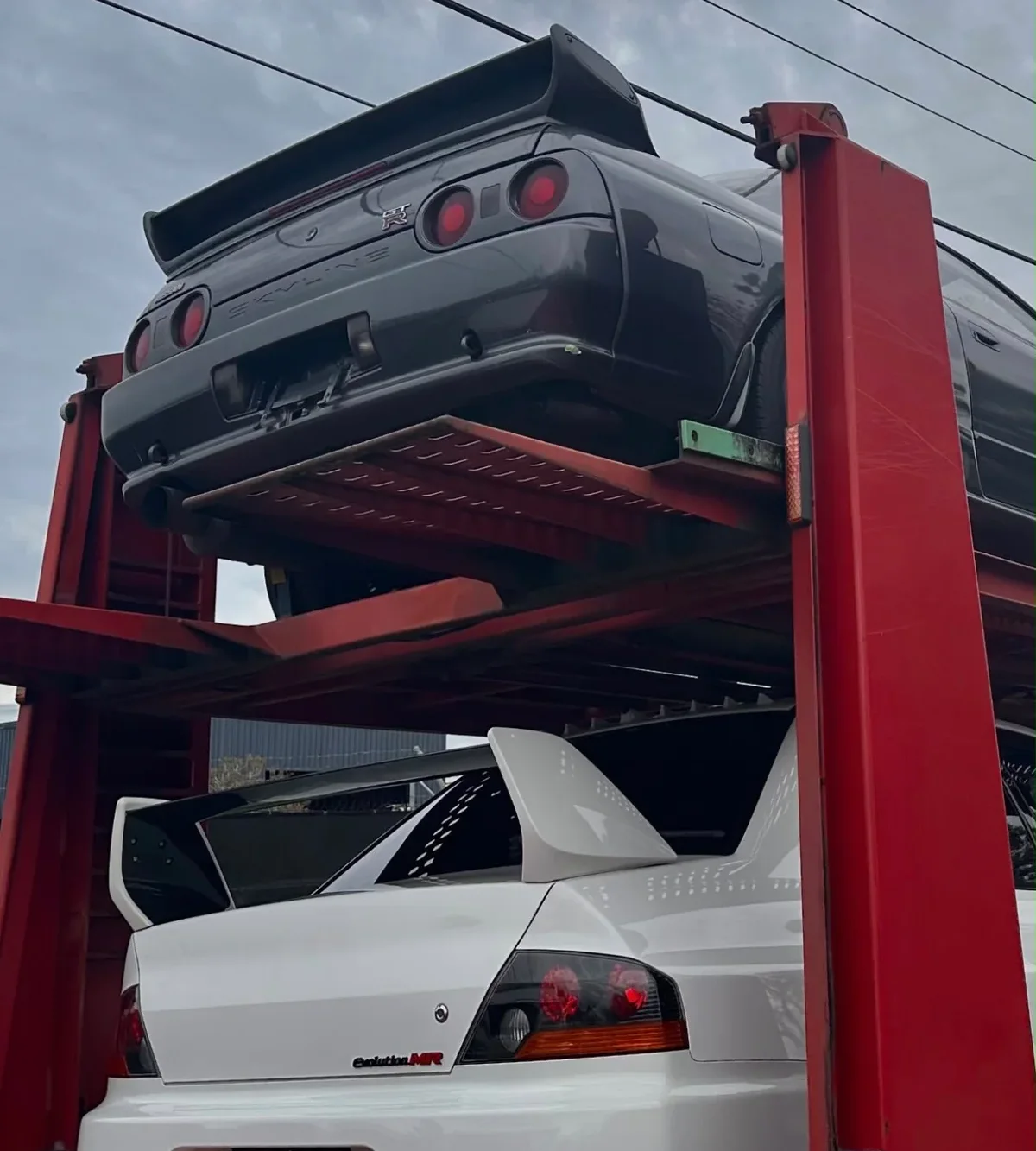
Our guide to what it costs to import a car from Japan shows what each of these stages costs and how long it usually takes.
How SEVS compares with the 25-year rule
The two routes end in the same place, a car on the RAV that can be registered, but they get there differently:
| SEVS | 25 years or older | |
|---|---|---|
| What makes it eligible | The model is on the SEV register | The car was built at least 25 years ago |
| Modifications to meet the ADRs | Required, following the approved Model Report | Generally required by the states, to the ADRs that applied at the car’s build date |
| How the work is planned | A ready-made blueprint: the Model Report’s Work Instructions, carried out by a Registered Automotive Workshop and inspected by an Authorised Vehicle Verifier | No Model Report. What each car needs is worked out individually against the state’s requirements, usually the build-date ADRs |
| Before registration | Entry on the RAV, then roadworthy | Entry on the RAV, then any work the state requires, and a roadworthy |
| Examples | Lancer Evolution VIII, Toyota Crown GRS204 | Toyota MR2 SW20, Honda Beat PP1 |
A common misconception is that cars imported under the 25-year rule skip the ADRs. They do not. An older car generally has to meet the ADRs that applied at its build date, as if it had been sold new in Australia at the time, and it is modified accordingly before it can be registered. The exact requirements are set by each state. The real difference is the starting point. For a SEVS car, the Model Report is a ready-made blueprint, with the modifications already worked out and approved. For an older car there is no blueprint, so the work is assessed car by car. If a car has been significantly modified within the last 25 years, it can also lose its older vehicle status altogether, which is one more reason to favour original cars.
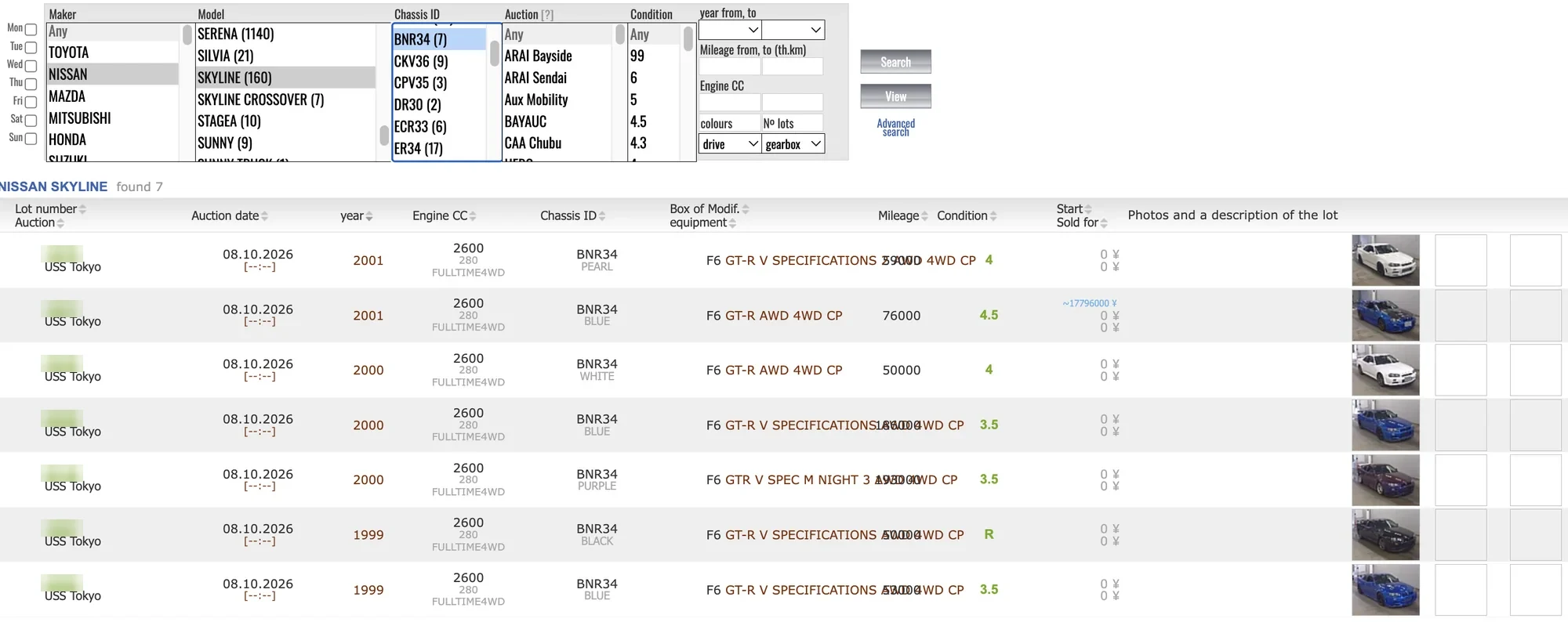
Some models qualify under both routes. The R34 Skyline GT-R, for example, is on the SEV register, and its earliest cars have now also passed 25 years.
What this means when you are choosing a car
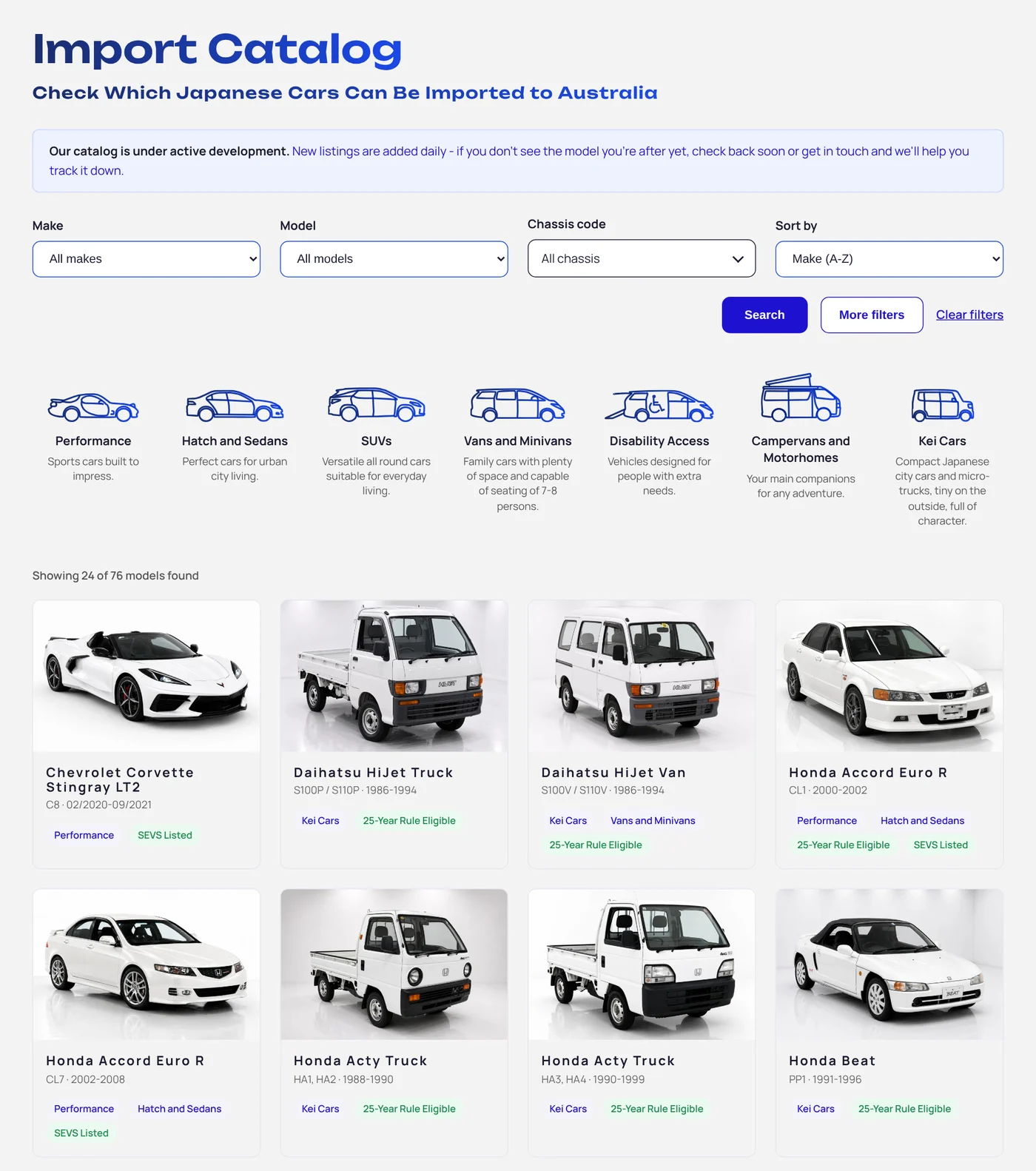
Before you fall for a particular car, it is worth knowing which route it will take. A model that is not on the SEV register generally cannot be imported until it turns 25, however rare it is in Australia, apart from narrow exceptions such as personal imports by people moving to Australia. A model that is on the register still needs a current entry that covers its build date, an approved Model Report and a workshop able to do the work. Our import catalogue shows which route each model falls under.
We are actively developing and maintaining our import catalogue to help buyers see which popular cars are being imported into Australia and understand how each one qualifies. New models are added regularly. Our aim is to make your import journey as simple and as enjoyable as possible: we help you find eligible cars, then organise the whole process from start to finish.
Choosing the right importer matters as much as choosing the right car. Your car has to be exported from Japan and legalised in Australia properly, with the correct type of import approval applied for and issued in good time. Mistakes at this stage can add significant cost and delays, and in some cases a car that has already arrived in Australia cannot be complied and registered for road use. That is why it pays to work with an importer you can trust to get each step right.
Our $250 car search is the easiest way to start. We check eligibility for every car we send you before you commit, and once you buy, we organise all the paperwork for the import approval, customs and biosecurity clearance, and compliance. If you would rather talk it through first, call us on +61 404 312 508.
Disclaimer: this article provides general information only and reflects our understanding of the Road Vehicle Standards framework at the time of writing. It is not legal, compliance or financial advice. Fukasawa Car Imports does not warrant or guarantee that any vehicle is eligible for import, entry on the SEV register, compliance or registration in Australia. Eligibility is determined solely by the Australian Government and state and territory registration authorities, and SEV register entries, Model Reports and regulations can change, be amended or expire without notice. Always confirm current eligibility for a specific vehicle on the official SEV register and with our team before purchasing. Nothing in this article excludes any right that cannot lawfully be excluded under the Australian Consumer Law.
Find us on socials
Our contacts